
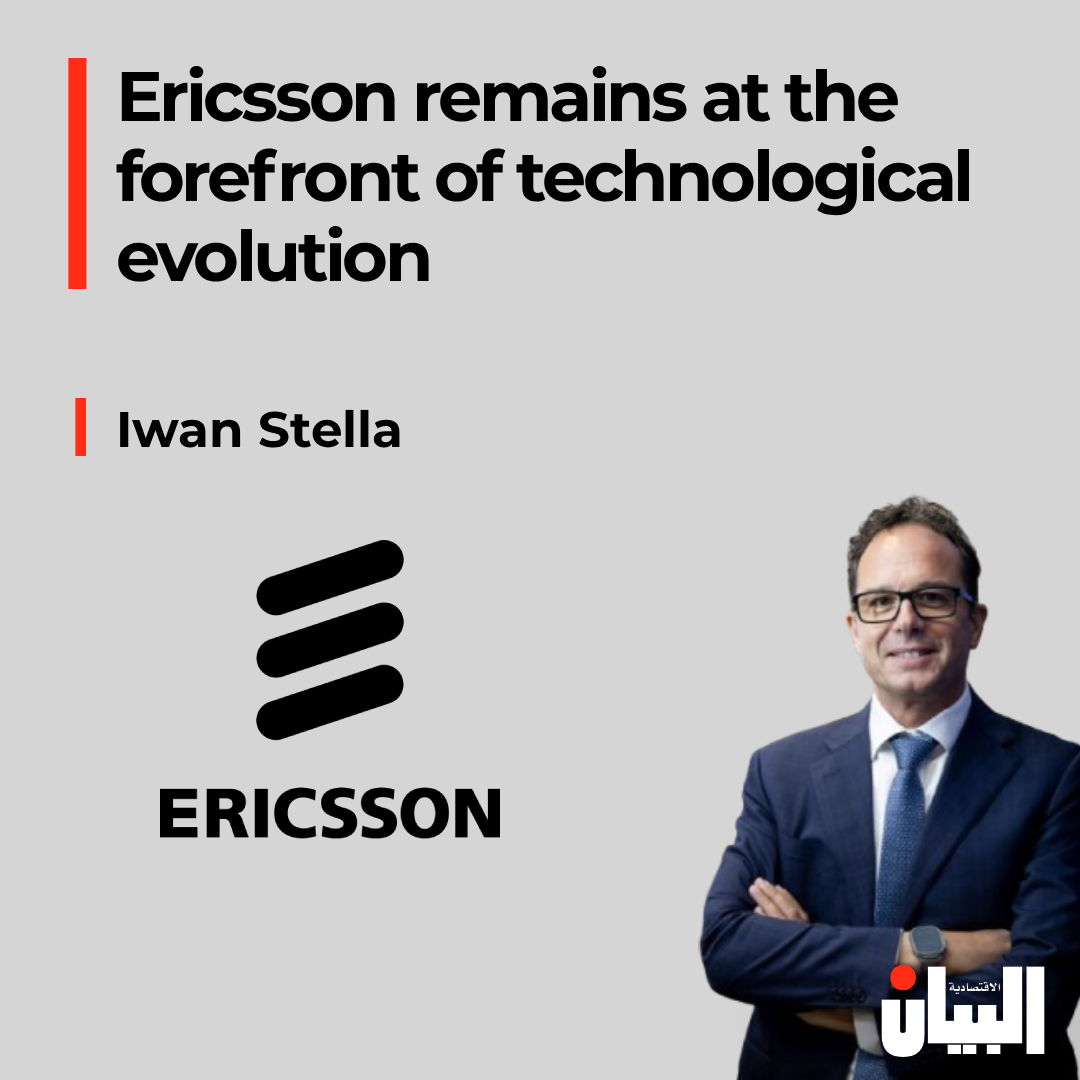
Ericsson remains at the forefront of technological evolution
Our role is to fully understand the specific business opportunities of operators rather than educate them
We are heavily investing in the horizontalization of networks
Ericsson, a global leader in telecommunications and networking solutions, has been at the forefront of driving digital transformation and enabling next-generation connectivity across the world. Central to its strategic growth in the EMEA region is Iwan Stella, Vice President and Head of Strategy and Commercial Management, whose leadership and vision guide Ericsson’s commercial initiatives and strategic partnerships. With a deep understanding of market dynamics and technological innovation, Mr. Stella plays a pivotal role in shaping Ericsson’s approach to delivering sustainable value and advancing the adoption of cutting-edge solutions across diverse industries. Al Bayan Magazine sat down with Mr. Stella for an exclusive interview. Following is the Q&A.
• What are the most significant market trends in the EMEA region today that Ericsson is leveraging for growth, and which of these trends is likely to have the longest-lasting impact?
– Ericsson remains at the forefront of technological evolution, and in the EMEA region-spanning Europe, the Middle East, and Africa-we see markets at different stages of 5G adoption. Some advanced markets are moving toward 5G Standalone, which Ericsson considers the “real” 5G, unlocking the full potential of the network. Meanwhile, many countries are just entering the 5G era, and our portfolio is designed to support every stage of this technology, backed by significant R&D investments. A key trend we are leveraging is cybersecurity: with 5G networks becoming national critical infrastructure, security is paramount. Ericsson emphasizes zero-trust architecture, openness, and full transparency to enable operators and governments to trust the infrastructure. Another major trend is the integration of 5G networks with hyperscalers and the AI ecosystem, creating a fully integrated infrastructure. In today’s geopolitically tense environment, nations must carefully plan their network deployment across core, transport, and radio access layers, balancing speed, cost, and security. Ericsson promotes evaluating the total risk of ownership, helping operators and policymakers assess the cybersecurity implications of their infrastructure and ensuring sovereign control of data through open, certified systems. Of all these trends, the focus on network security and sovereignty is likely to have the longest-lasting impact, as it defines how countries build and protect their critical digital infrastructure for decades to come.
• How is Ericsson embedding sustainability in its products and services?
– Ericsson approaches sustainability through multiple dimensions, including reducing energy impact and fulfilling social responsibility by positively impacting the communities where its technology is introduced. The company is committed to responsible and sustainable growth, ensuring that every development aligns with this objective. At GITEX, Ericsson showcased several initiatives across the EMEA region that demonstrate its sustainable approach to technology deployment. These initiatives focus on reducing energy costs, optimizing network performance with AI, and building one of the most energy-efficient and cost-effective portfolios in the industry. Ericsson has set a clear target to achieve net-zero emissions by 2040 and is already halfway toward that goal. Through hardware innovation, software enhancements, and AI-driven network optimization that anticipates traffic demands, the company manages energy consumption efficiently without compromising end-user performance.
• What role do partnerships play in unlocking new net revenues?
– Partnerships are central to unlocking new net revenues by enabling a collaborative ecosystem. Ericsson, for example, has launched a joint venture with Aduna, creating a marketplace that allows the entire ecosystem of CSPs and other industry players to leverage network attributes. By exposing highly monetizable network parameters through APIs, developers can build applications in a federated way, overcoming the limitations of a fragmented ecosystem and achieving scale. This pioneering approach is already generating promising use cases that operators and the broader ecosystem can monetize. Additionally, Ericsson supports enterprises in every market through 5G standalone capabilities, enabling hybrid networks and network slices dedicated to specific enterprises or agencies. Combined with Ericsson Private 5G deployments, this allows for localized, secure networks where end users can control their data; providing maximum flexibility and security while creating new revenue opportunities.
• How does Ericsson demonstrate that 5G Enterprise and vertical strategies can deliver tangible revenue rather than just promises?
– We don’t need to convince operators, as they are already highly knowledgeable and recognize the opportunities. Our role is not to educate or persuade them, but to deeply understand the specific business opportunities they have. We then help them deliver the right solutions quickly and efficiently, enabling early monetization and real value creation.
• What future innovations is Ericsson developing to help operators reduce costs and improve sustainability?
- Ericsson is heavily investing in the horizontalization of networks, offering solutions such as rApps, which are horizontal applications across the entire technology stack. These rApps optimize networks in real time and allow operators, as well as third parties, to develop applications on top of the network, effectively turning it into a monetizable platform. Another major focus is AI-driven automation, which enables autonomous networks capable of self-configuration. By leveraging generative AI and intelligent agents, Ericsson allows networks to operate efficiently without constant human intervention, reducing costs and freeing staff for higher-skilled roles. This approach not only enhances operational efficiency and sustainability but also supports operators in monetizing their networks and accelerating time-to-market. Overall, Ericsson’s vision is to enable responsible growth by transforming networks into secure, versatile platforms that benefit the entire ecosystem.
ربما يعجبك أيضا

شركة OneDegree تحصل على تمويل من شركة دبي للتأمين
أبرمت OneDegree، أول شركة مرخصة في آسيا لتأمين الأصول ال

Business Tabloid Awards: Celebrating Visionary Leadership in Dubai
The 6th Annual Business Tabloid Awards, the region’s premier recognition of corporate achievement

كويتيون يؤسسون بورصة في اميركا
طلال البحر: لم ترخص لنا الكويت فرخصت لنا اميركا بعد ان ر



انشر تعليق